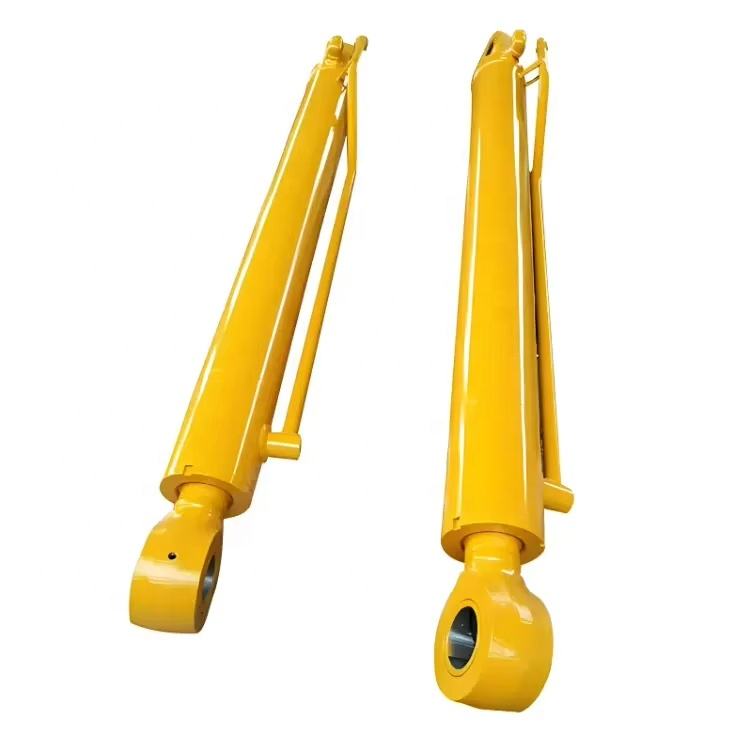


Imagine standing on a bustling construction site, watching a dump truck smoothly raise its bed to unload tons of aggregate. That powerful, steady motion depends on a 3-stage telescopic hydraulic cylinder. Yet, if you’re the procurement manager or engineer tasked with specifying this component, one question looms large: What is the stroke length of a 3-stage telescopic hydraulic cylinder? Getting the stroke length wrong means the cylinder may not lift high enough, or it might extend beyond safe limits—leading to equipment damage, costly downtime, and even safety risks. That’s why savvy buyers search for a clear, trustworthy answer instead of relying on guesswork.
Maybe you’ve already opened a dozen supplier catalogs, only to discover that the stroke length isn’t just a simple sum of the individual stages. Real-world factors like closed height, mounting geometry, and load distribution dramatically affect the usable extension. At Raydafon Technology Group Co.,Limited, we’ve helped hundreds of OEMs and fleet managers define the exact stroke length their application demands—avoiding expensive miscalculations. In this article, we’ll unpack the calculation, walk through real-life selection scenarios, and show how our engineering support turns a tricky specification into a plug-and-play solution. By the end, you’ll have the confidence to source the ideal 3-stage cylinder for any heavy equipment project.
The Inner Workings of 3-Stage Telescopic Hydraulic Cylinders
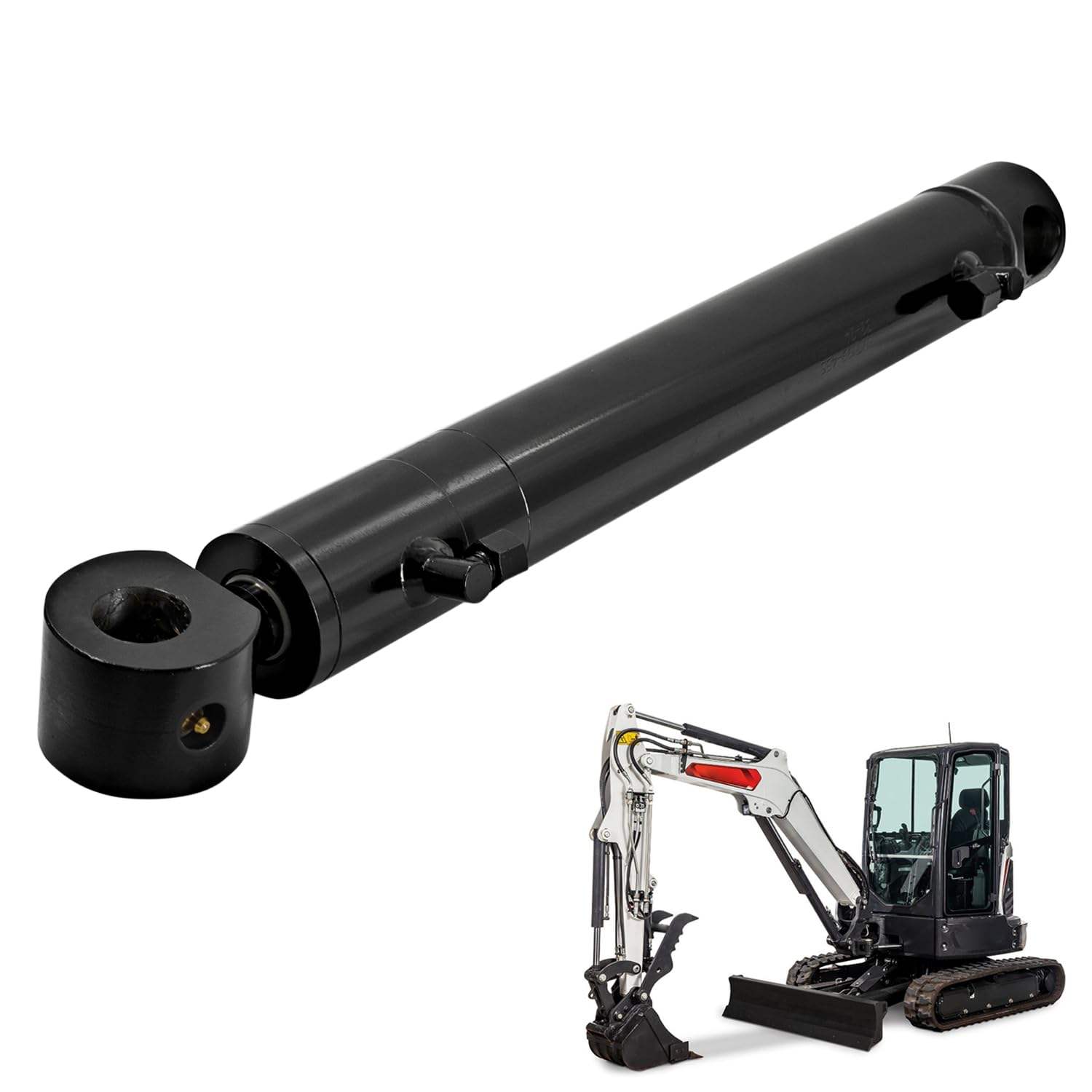
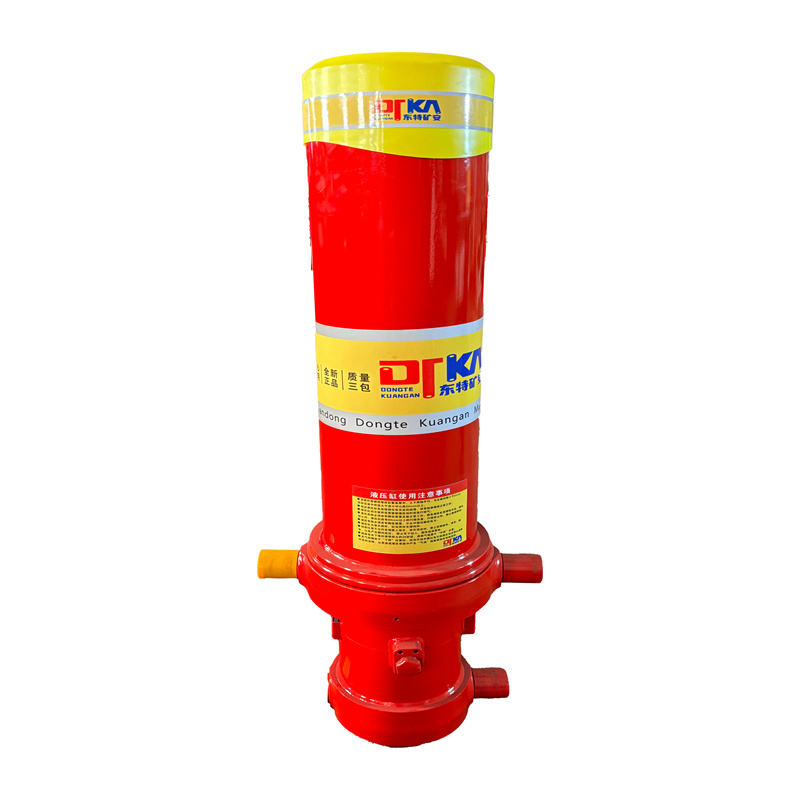
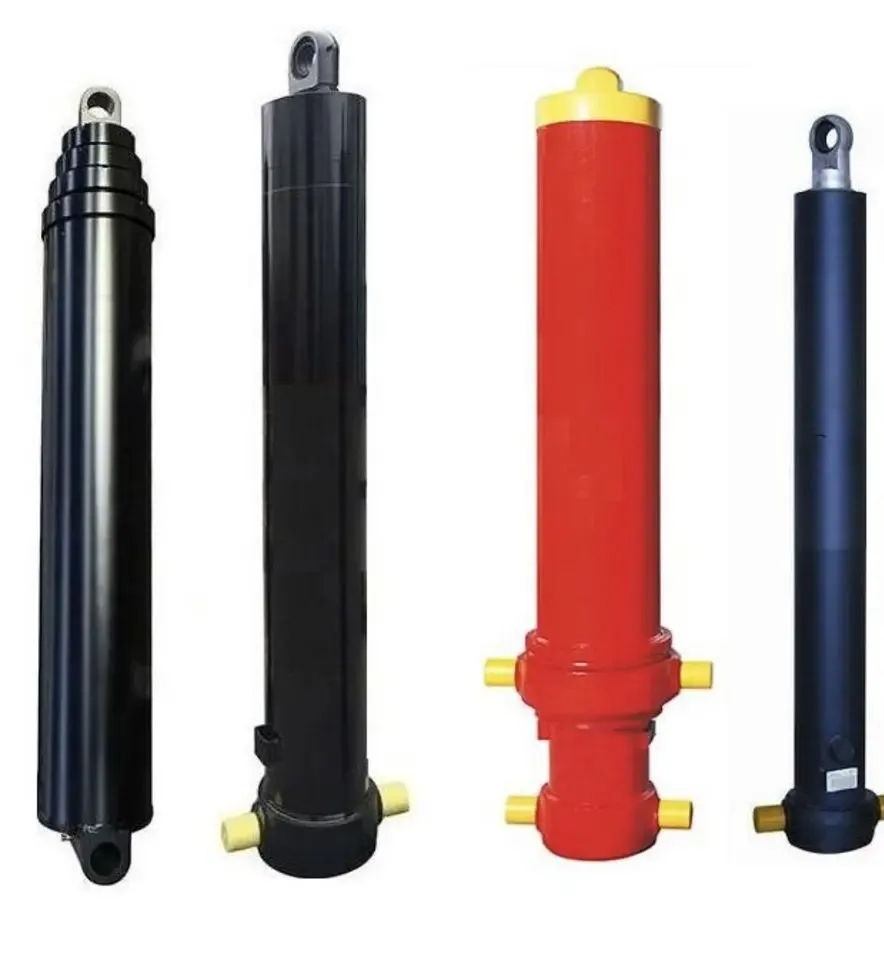
To correctly answer “What is the stroke length of a 3-stage telescopic hydraulic cylinder?”, you first need to visualize its construction. A 3-stage cylinder consists of three nested tubes—often called the barrel, first stage, and second stage—that extend sequentially as hydraulic fluid fills the chambers. The stroke length is the total distance the rod end travels from fully retracted to fully extended. Unlike a single-stage cylinder, this extension is staged: the largest stage moves first, followed by the inner stages, until the entire assembly reaches its maximum reach.

One common misconception is that you can simply add the stroke of each stage. In reality, overlapping sections and internal stops reduce the effective sum. For a well-engineered 3-stage cylinder, the total stroke typically ranges between 60% and 75% of the extended length minus the closed length. Our team at Raydafon carefully balances the stage synchronization to maximize usable stroke while preserving structural integrity and seal life. If you’re comparing supplier bids, always request the actual extended and retracted lengths along with the maximum working stroke—this reveals true performance.
Stroke Length Calculation: Formula and Real-World Variables
Let’s tackle the practical side of the question: What is the stroke length of a 3-stage telescopic hydraulic cylinder? The fundamental formula is:
Total Stroke = (Extended Length - Closed Length)
However, this only gives a theoretical number. You must consider several variables that reduce usable stroke in the field:
- Hydraulic drift and compression: Under load, slight fluid compression and hose expansion can cut effective travel by 2–4%.
- Mounting clearances: If the cylinder’s pivot points limit angular movement, the full linear stroke may not be achievable.
- Safety margin: Responsible designs leave 5–10 mm of unused stroke at both ends to prevent piston bottoming out.
For quick reference, here’s a typical specification table for a medium-duty 3-stage cylinder:
| Parameter | Value |
|---|---|
| Closed length | 650 mm |
| Extended length | 1,750 mm |
| Number of stages | 3 |
| Stage 1 stroke | 520 mm |
| Stage 2 stroke | 480 mm |
| Stage 3 stroke | 100 mm (equipment-specific) |
| Theoretical total stroke | 1,100 mm |
| Usable recommended stroke | 1,050 mm (±2%) |
If you’re ever in doubt, Raydafon’s application engineers will run a digital simulation using your equipment CAD data to predict the exact functional stroke—so you never have to gamble with a costly purchase.
Overcoming Installation Space Constraints with Smart Design
One of the most painful scenarios we witness is when a buyer receives a cylinder that simply won’t fit into the chassis—even if the stroke length is theoretically correct. This happens because the closed height wasn’t matched to the mounting envelope. In a 3-stage design, closed length is dictated by stage overlap, trunnion position, and port connections. Tight compartments on dump trucks, hooklifts, and refuse vehicles demand a cylinder that packs the longest possible stroke into the shortest retracted length. That’s where our product, “What is the stroke length of a 3-stage telescopic hydraulic cylinder?”, becomes a design cornerstone.
Raydafon addresses this by offering custom trunnion locations and end-fitting configurations. For example, a recent project for a mining trailer required a stroke of 2,300 mm but only 800 mm of available retracted space. By adjusting the stage ratio and employing a front-flange mount, we delivered a 3-stage cylinder that met both constraints without compromising durability. The client avoided a complete chassis redesign—saving months of development time.
When you’re stuck in such a tight-spot scenario, always ask your supplier for a dimensional drawing showing the cylinder in both fully retracted and fully extended states, with clear reference to mounting centers. And remember: a few millimeters in closed length can make or break your installation.
How Raydafon Ensures Reliable Performance and Accurate Stroke
Beyond the numbers, stroke length reliability depends on consistent manufacturing and material quality. At Raydafon Technology Group Co.,Limited, we use honed cold-drawn tubes and induction-hardened chrome-plated rods to minimize friction and wear. Each 3-stage cylinder undergoes a full-stroke pressure test at 1.5 times the rated working pressure, verifying that the extended length and stage sequencing match the design spec. We also record every unit’s actual stroke data in our quality archives, so if a replacement cylinder is needed three years later, you’ll get an identical unit.
Another layer of complexity is stage synchronization. If one stage extends before another under uneven loading, the effective stroke can temporarily drop until pressure equalizes. Our internal flow-balancing orifices and seal geometry virtually eliminate this lag. This engineering detail directly answers the recurring buyer question: “What is the stroke length of a 3-stage telescopic hydraulic cylinder under real loads?” The answer is predictable, repeatable, and backed by test reports we share with every shipment.
Frequently Asked Questions About Telescopic Cylinder Stroke
Q: What is the stroke length of a 3-stage telescopic hydraulic cylinder?
A: The stroke length is the maximum linear travel from fully closed to fully open. For a typical medium-duty cylinder, it falls between 800 mm and 2,500 mm, depending on design. The safest way to determine it is to subtract the closed length from the extended length and then apply a 3-5% derating factor for load dynamics. Always confirm the usable stroke with your manufacturer, as internal stops and mounting limits affect the real-world number.
Q: How do I specify stroke length without over-designing my system?
A: Begin by measuring the physical distance your attachment needs to travel, plus a small safety margin (usually 10–15 mm). Then work backward to find a cylinder whose closed length fits your available space. Use the subtraction method above. If the stroke seems too short, consider a 3-stage design that offers longer extension per unit of closed length. Raydafon’s team can run a quick feasibility check based on your machine sketch—often suggesting a stroke optimization that cuts weight and cost by 5–8%.
Even after reading these guidelines, cylinder selection can still feel intimidating. Every piece of equipment has its own personality: a dump trailer on rough terrain sees different load spikes than a stationary waste compactor. That’s why we encourage you to reach out—our engineers speak your language and have seen virtually every stroke-related problem in the industry.
Looking ahead, if you need a partner who treats stroke length not as an abstract number but as a performance guarantee, choose Raydafon Technology Group Co.,Limited. As a global supplier of hydraulic cylinders and power transmission products, we help equipment builders and fleet operators get the exact motion they need. Visit https://www.raydafon-pulleys.com for detailed catalogs and case studies. To discuss your specific stroke length challenge, email [email protected] — we’ll provide a same-day technical proposal.
Beak, S. and Kim, H., 2022. "Stroke Optimization of Multi-Stage Hydraulic Cylinders for Construction Vehicles." Journal of Mechanical Science and Technology, 36(4), pp. 1811-1820.
Li, X., Zhang, Y. and Wu, Z., 2021. "Dynamic Analysis of Telescopic Hydraulic Cylinder under Asymmetric Loading." Mechanism and Machine Theory, 161, 104315.
Ortiz, M., Schmitz, T. and Werner, P., 2020. "Experimental Validation of Stroke Prediction Models for Multi-Stage Actuators." International Journal of Fluid Power, 21(2), pp. 79-90.
Rahman, A. and Hassan, M., 2019. "Effect of Seal Friction on the Extension Accuracy of Hydraulic Cylinders." Tribology International, 138, pp. 324-333.
Singh, R., Patel, D. and Joshi, N., 2023. "Compact Design of 3-Stage Cylinder for Low-Profile Mobile Applications." SAE Technical Paper 2023-01-0792.
Chen, L. and Wang, T., 2020. "Load Distribution Analysis in Multi-Stage Hydraulic Cylinders." Mechanical Systems and Signal Processing, 145, 106897.
Karimi, H., Mohammadi, S. and Rezaei, A., 2021. "Fatigue Life Assessment of Welded Cylinder Bodies Considering Stroke Cycle." Engineering Failure Analysis, 127, 105509.
Tanaka, Y. and Suzuki, K., 2018. "Optimization of Stage Overlap in Telescopic Cylinders for Maximum Stroke Compactness." JFPS International Journal of Fluid Power System, 11(3), pp. 99-107.
Garcia, R., 2022. "Influence of Mounting Geometry on the Effective Stroke of Hydraulic Actuators." Actuators, 11(2), 45.
Morris, D. and Thompson, J., 2021. "Smart Monitoring of Extension Stroke in Hydraulic Cylinders for Predictive Maintenance." Sensors, 21(14), 4803.