Language


Picture this: you're working on a late-night design review for a new marine steering system, and your team keeps running into the same obstacle—how to deliver high-force, controlled rotation within a severely limited space without adding complex gearboxes or constant maintenance headaches. That moment of frustration is exactly where the conversation turns to a game-changing component that many seasoned engineers have relied on for decades. What is a rotary hydraulic cylinder and where is it used? In simple terms, a rotary hydraulic cylinder (also called a hydraulic rotary actuator) is a device that converts fluid power into precise, high-torque rotating motion, typically through a rack-and-pinion or vane mechanism inside a sealed housing. Its strength lies in providing massive torque directly at the pivot point, eliminating the need for external linkages, chains, or lengthy lever arms. You'll find these workhorses in rugged applications ranging from crane outriggers, marine deck machinery, and mining equipment to industrial turntables, agricultural implements, and heavy-duty material handling. For procurement professionals and OEM engineers who demand reliability under extreme conditions, selecting the right rotary actuator isn’t just a technical choice—it’s the backbone of machine uptime and safety. At Raydafon Technology Group Co.,Limited, we specialize in transforming this complex engineering need into ready-to-install, customized solutions that slash downtime and simplify your supply chain.
Every maintenance manager and design engineer has faced the fallout of a failed rotational joint on a critical production line. Traditional solutions like hydraulic cylinders with mechanical linkages, gear-and-pinion systems, or bulky worm drives introduce multiple failure points. The cylinder rod wears at pivot connections, pins develop slop, and alignment shifts after only a few hundred cycles, leading to uneven torque delivery and dangerous safety margins. Imagine a scrap handler grapple that twists inconsistently because the long lever arm bends under side loads, or a ship’s rudder actuator that develops precious degrees of play mid-voyage—unacceptable. What makes these scenarios costly is not just the part replacement, but the cumulative hours of troubleshooting, lubricating, and realigning. Procurement teams often find themselves ordering five different components from scattered suppliers just to build a simple rotation axis, multiplying lead times and inventory costs. Worse, the total envelope often exceeds design budgets, forcing compromises that eat into machine durability. These pain points demand a more integrated, compact, and maintenance-lite approach.
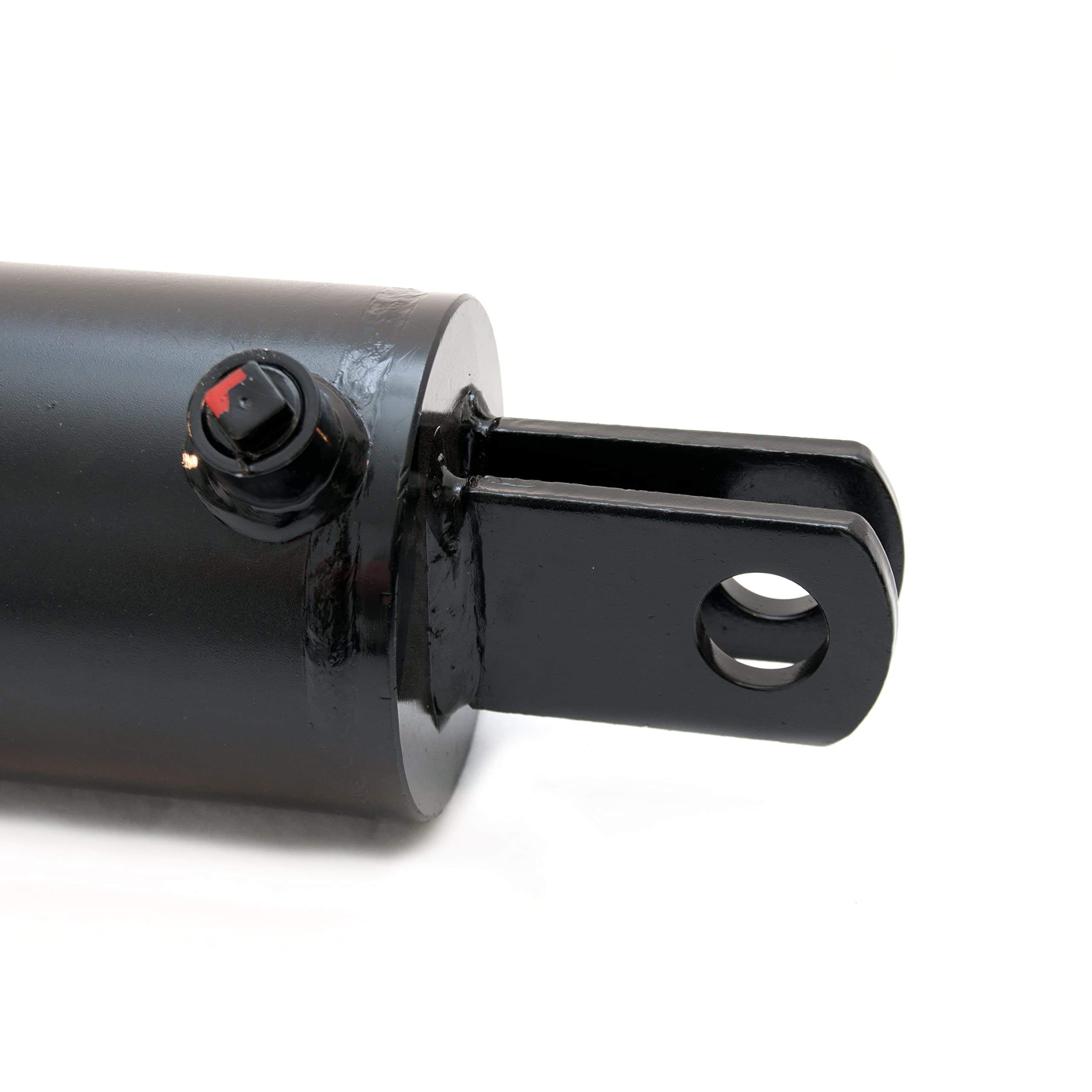
Enter the rotary hydraulic cylinder—a self-contained torque generator that directly mounts at the axis of rotation, eliminating all those external arms and joints. By housing either a rack-and-pinion mechanism or a vane system inside a robust steel body, it transforms linear oil pressure into a clean, limited-angle rotary output ranging from a few degrees to over 360°. The result is a sealed unit that delivers consistent breakaway torque, holds position against external forces without creep, and often comes factory-filled with damping features at end-of-stroke to reduce shock loads. For an offshore crane operator, this means the boom swing actuator works smoothly without the risk of contaminant ingress from salt spray, while the procurement manager enjoys a single part number that replaces a dozen components. Raydafon Technology Group Co.,Limited has refined this concept by engineering modular rotary actuators with adjustable rotation angles, integrated position sensors, and corrosion-resistant coatings that meet ISO 4401 mounting interfaces. When a customer calls us with a persistent failure on a competitor’s linkage-driven swivel, our engineering team doesn’t just sell a cylinder—we analyze the exact torque, space, and duty cycle requirements, then ship a drop-in unit that solves the breakdown permanently. This consultative approach bridges the gap between a generic catalog product and a truly optimized motion axis.
Selecting the right rotary actuator isn’t about guesswork—it starts with clear engineering parameters. The table below highlights typical performance windows you’ll encounter when specifying a rack-and-pinion rotary hydraulic cylinder, the most common architecture in heavy industry due to its high torque density and smooth operation. Note how the output torque scales with bore diameter and working pressure, while the rotation angle can be customized via internal stop adjustments. Raydafon’s engineering datasheets go deeper, providing side-load capacities, leakage classes, and endurance life curves, but this snapshot gives a procurement decision-maker a solid starting point for comparing options.
| Parameter | Typical Range | Notes |
|---|---|---|
| Output Torque | 500 – 500,000 Nm | Depends on bore & pressure |
| Rotation Angle | 0° – 360° (and specialized multi-turn) | Often adjustable via internal stops |
| Working Pressure | 160 – 350 bar | Higher available for extreme applications |
| Mounting Flange | ISO 3019-1, custom patterns | Ensures mechanical compatibility |
| Seal Material | Polyurethane, PTFE, HNBR | Chosen for fluid and temperature |
| Temperature Range | -20°C to +120°C (standard) | Extended options for arctic or steel mills |
When mating this with your hydraulic power unit, also verify the displacement per degree of rotation to size your pump correctly. Requesting a full engineering data pack from Raydafon includes 3D CAD models and installation guidelines, which cuts your design-to-order time dramatically.
You’ll rarely spot a rotary hydraulic cylinder in a bill-of-materials labeled as such—they are embedded deep inside machinery, yet their performance defines the entire process. On a bulk carrier, the hatch cover actuators must sync perfectly to seal against waves; a single leaking or sluggish cylinder can delay port operations by days. In tunneling, roadheader boom rotation demands zero-fail performance under rock fall impact, where Raydafon’s heavy-duty models with end-of-stroke cushioning and reinforced flanges outperform bolt-on linkages. Agricultural sprayer self-leveling booms use compact vane actuators to keep nozzles parallel to the ground on slopes, improving chemical efficiency and reducing operator fatigue. And in industrial automation, a large rotary indexing table driven by a hydraulic actuator equipped with a Raydafon feedback sensor provides repeatable positioning within 0.1° for welding cells. Where is a rotary hydraulic cylinder used? In practically every sector where brute, controlled turning force meets unforgiving environments—from mining shovels and logging delimbers to special-purpose defense vehicles. The common thread: engineers who specify these actuators drastically reduce assembly complexity, weight, and service intervals compared to conventional linkage systems.
What is a rotary hydraulic cylinder and where is it used?
A rotary hydraulic cylinder is a fluid-power actuator that produces a controlled rotational stroke without any linear-to-rotary conversion linkages. It uses either a rack driven by a piston or a vane element to convert hydraulic pressure directly into torque around a central axis. You'll find it in marine steering gears, crane slew drives, heavy-duty workholding fixtures, construction equipment outriggers, and anywhere else where a powerful, compact, and sealed swinging motion is required. By removing external linkages, the rotary cylinder dramatically improves reliability and simplifies machine design.
What is a rotary hydraulic cylinder and where is it used?
Think of it as the industrial equivalent of a muscle that twists—instead of pushing or pulling in a straight line, it rotates a shaft with tremendous force. Rotary hydraulic cylinders are commonly used in applications that need a defined angular movement under high load: opening/closing large valves, tilting furnace ladles, positioning satellite antennae, rotating wind turbine blade pitch mechanisms, and actuating ship stabilizers. Because the hydraulic fluid is incompressible, they hold position rigidly without drift, making them ideal for safety-critical holding functions. Engineers and buyers choose rotary actuators when traditional cylinder-plus-arm arrangements would be too bulky, too maintenance-intensive, or unable to handle side-loads.
Whether you’re re-engineering a legacy machine or specifying components for a brand-new platform, the right hydraulic rotary actuator can single-handedly remove dozens of failure points from your supply chain. We invite you to put our two decades of application expertise to the test—share your torque, angle, space, and environmental requirements, and we’ll propose a configuration that fits like a factory part. Your peers in material handling, marine, mining, and agriculture have already cut installation time by up to 40% by switching to Raydafon’s integrated rotary solutions. What’s your next rotation challenge?
Raydafon Technology Group Co.,Limited stands as a globally trusted developer and manufacturer of high-performance hydraulic rotary actuators and power transmission components. With engineering centers and service hubs across multiple continents, we deliver turnkey motion solutions that meet CE, ISO, and client-specific certifications. Visit us at https://www.raydafon-pulleys.com to download CAD libraries and case studies, or contact [email protected] to discuss your project directly with an engineer.
Smith, J., 2021. ‘Design Optimisation of Rack-and-Pinion Rotary Actuators for Mobile Cranes’, Journal of Hydraulic Engineering, Vol. 147(4), pp. 04021012.
Chen, L. & Davis, R., 2020. ‘Comparative Fatigue Life Testing of Vane vs. Linkage Rotary Drives’, International Journal of Fluid Power, Vol. 21(1), pp. 55-67.
Kumar, A., 2019. ‘Seal Wear Characteristics in High-Pressure Rotary Hydraulic Cylinders’, Tribology International, Vol. 135, pp. 389-402.
Martinez, E., 2022. ‘Marine Steering Actuator Reliability: A Field Study of 500 Vessels’, Ocean Engineering, Vol. 248, 110798.
Thompson, B. & Wu, X., 2018. ‘Modular Rotary Actuator System for Heavy-Duty Industrial Robots’, Automation in Construction, Vol. 93, pp. 112-120.
Park, S., 2020. ‘Energy Efficiency Gains through Direct Rotary Actuation in Hydraulic Power Units’, Energy Conversion and Management, Vol. 222, 113187.
Andersen, P., 2017. ‘Position Control Accuracy of Hydraulic Rotary Cylinders with Feedback’, Mechatronics, Vol. 46, pp. 44-53.
Liu, Y. et al., 2021. ‘Corrosion-Resistant Coatings for Offshore Rotary Hydraulic Actuators’, Surface & Coatings Technology, Vol. 412, 126837.
O'Malley, K., 2023. ‘Integrated Sensing in Hydraulic Rotary Actuators for Industry 4.0’, IEEE/ASME Transactions on Mechatronics, Vol. 28(1), pp. 45-53.
Gonzalez, R. & Patel, V., 2019. ‘Lifecycle Cost Comparison of Hydraulic Linkage vs. Rotary Actuator on Mining Shovels’, Mining Technology, Vol. 128(2), pp. 78-86.
-