Language


Imagine you’re standing on the factory floor, a worn V-belt drive in front of you. The conveyor is running too slow, and production is backing up. The maintenance manual is lost, and you’re left with one burning question: How do I calculate the pulley ratio for a V belt drive? It’s a moment every procurement specialist and plant engineer faces – replacing a belt drive without the original specs, or designing a new system to meet precise speed requirements. Miscalculating the ratio can mean downtime, expensive reworks, or even equipment damage. The good news is that pulley ratio calculation is a straightforward process once you understand the core principles. This guide walks you through the steps in plain language, backed by real-world scenarios and practical solutions from Raydafon Technology Group Co.,Limited, a leader in power transmission components. Whether you’re sourcing replacement pulleys or building a custom drive, mastering this calculation puts you in control of uptime and efficiency.
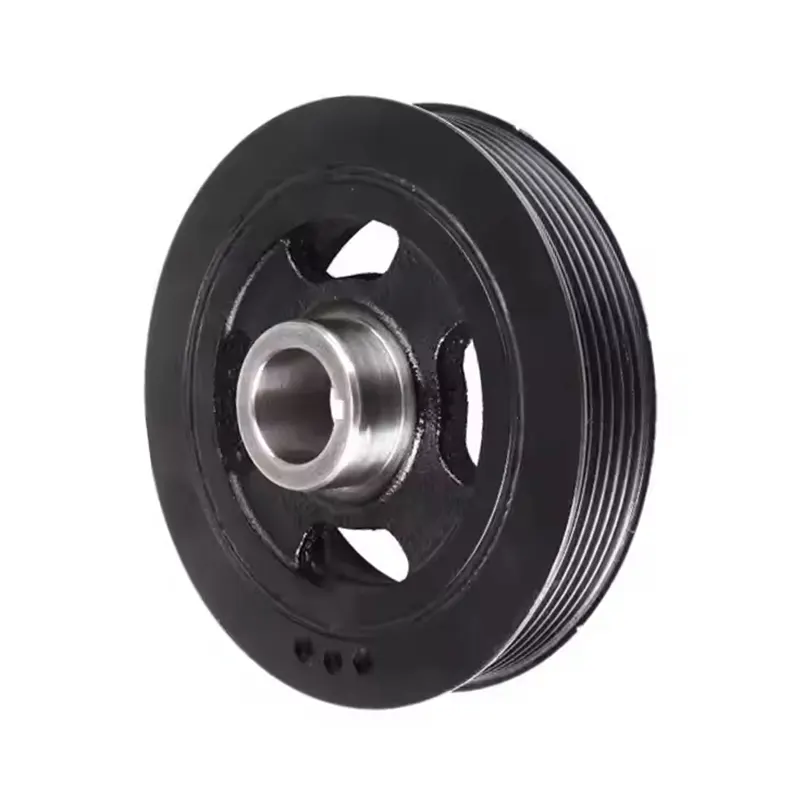
A junior engineer inherits a misbehaving mixer drive. The motor spins at 1750 RPM, but the output shaft only turns at 700 RPM – production targets are missed. The root cause is often an incorrect pulley ratio. The pulley ratio, or speed ratio, directly determines how rotational speed is increased or decreased between two shafts connected by a V-belt. At its simplest, the ratio is calculated using the pitch diameters of the driving and driven pulleys. Think of it as a gear exchange: a larger driving pulley spins the driven pulley faster (overdrive), while a smaller one reduces speed (underdrive). For procurement, knowing the correct ratio means ordering the right parts the first time and avoiding costly returns. Raydafon Technology Group Co.,Limited supplies a wide range of V-belt pulleys in standard and custom diameters, all precision-machined for reliable speed control. The table below shows typical pairings for a 1750 RPM motor, demonstrating the impact of diameter choices.
| Driver Pulley Diameter (mm) | Driven Pulley Diameter (mm) | Pulley Ratio | Output Speed (RPM) |
|---|---|---|---|
| 80 | 200 | 0.40:1 | 700 |
| 100 | 200 | 0.50:1 | 875 |
| 120 | 160 | 0.75:1 | 1312 |
| 160 | 100 | 1.60:1 | 2800 |
On a Monday morning, a purchasing manager needs to quote replacement pulleys for a fan drive. The only available data: motor speed is 1450 RPM, desired fan speed is 580 RPM, and the existing driven pulley measures 250 mm in diameter. How do you find the driver pulley size? First, apply the fundamental formula: Ratio = Driver Speed / Driven Speed. Here, the ratio is 1450 / 580 = 2.5. Because the ratio is also equal to Driven Pulley Diameter divided by Driver Pulley Diameter (for speed reduction), you rearrange: Driver Diameter = Driven Diameter / Ratio = 250 mm / 2.5 = 100 mm. Therefore, a 100 mm driver pulley is needed. Raydafon’s technical team can confirm your calculations and cross-check belt length requirements to ensure a robust system. Below is a quick reference chart for common diameter relationships and the resulting speeds when the driver runs at 1450 RPM.
| Driver Diameter (mm) | Driven Diameter (mm) | Ratio | Driven Speed (RPM) |
|---|---|---|---|
| 80 | 200 | 2.50:1 | 580 |
| 100 | 200 | 2.00:1 | 725 |
| 120 | 180 | 1.50:1 | 967 |
| 150 | 150 | 1.00:1 | 1450 |
Q: How do I calculate the pulley ratio for a V belt drive if I only know shaft speeds?
A: Divide the driver shaft speed (RPM) by the driven shaft speed. For example, if the motor runs at 1800 RPM and the machine shaft runs at 600 RPM, the ratio is 3:1. This ratio also equals the inverse of the diameter ratio, so the driven pulley must be three times larger than the driver pulley.
A packaging line suddenly stops because belts are slipping every few hours. The shift supervisor suspects the pulleys, but the diameters seem correct. The real villain is often an improper pulley ratio combined with marginal belt tension or misalignment. An incorrect ratio can overload a belt, causing premature wear, heat buildup, and slip. In procurement, ordering a driver pulley that is too small for the load may save upfront cost but leads to frequent replacements. Another trap is using outside diameter instead of pitch diameter for calculations—especially with deep-groove pulleys, the difference can alter the ratio by 3–5%. Raydafon Technology Group Co.,Limited helps buyers avoid these issues by providing detailed dimensional data and material certifications with every pulley. Always verify the pitch diameter from the manufacturer’s catalog, and double-check that the ratio fits within the belt’s power capacity curve.
Q: What happens if the pulley ratio is incorrect?
A: An incorrect ratio leads to one of two problems: if the driven pulley spins too fast, equipment may be damaged or produce off-spec products; if too slow, productivity drops. Additionally, extreme mismatches increase belt tension differences, causing slip, overheating, and a sharp reduction in belt life. Correct calculations upfront prevent these hidden costs.
After crunching the numbers, you have the target diameters. But no drive is complete without the right pulley configuration. The procurement specialist must consider bore size, taper bush, material (cast iron, steel, or aluminum), and groove profile (SPZ, SPA, SPB, SPC). A water pump in a harsh environment demands a corrosion-resistant pulley, while a high-speed fan calls for dynamically balanced steel. Raydafon Technology Group Co.,Limited stocks thousands of V-belt pulley variants and offers custom machining to match any ratio precisely. Their engineers can even propose alternative diameter pairs that maintain the same ratio while using off-the-shelf pulleys, reducing lead time. Below is a selection guide based on common industrial scenarios.
| Application | Material | Groove Type | Ratio Range | Typical Diameter (mm) |
|---|---|---|---|---|
| Light-duty conveyor | Cast iron | SPZ | 1:1 – 2:1 | 50 – 250 |
| Industrial fan | Steel | SPA | 2:1 – 4:1 | 100 – 400 |
| Crusher drive | Ductile iron | SPC | 3:1 – 6:1 | 200 – 800 |
| Precision machine tool | Aluminum | SPZ | 1:1 – 1.5:1 | 40 – 160 |
Even a perfectly calculated pulley ratio can fail if installation is rushed. Picture a sawmill where the new pulleys were bolted on in a hurry, and vibration destroyed the bearings within a week. Proper alignment of pulleys—both angular and parallel—is critical. Use a straightedge or laser alignment tool to ensure the faces are flush within 0.5 degrees. Belt tension should follow the 1/64″ deflection per inch of span rule; too loose causes slip, too tight overloads bearings. Raydafon Technology Group Co.,Limited supplies matched belt and pulley kits with setup instructions, eliminating guesswork. After installation, run the drive for 30 minutes and recheck tension, as new belts seat into the grooves. These small steps protect your capital equipment and maximize the benefit of an accurate ratio calculation.
Have a tough application or need help verifying your pulley ratio? Share your specs in the comments or reach out directly—we’re here to simplify your sourcing journey. At Raydafon Technology Group Co.,Limited, we combine decades of power transmission expertise with a comprehensive inventory of V-belt pulleys, taper bushes, and drive components. Our technical support team helps you select the exact diameters and materials to meet your speed, torque, and environmental requirements, minimizing downtime and total cost of ownership. Explore our full range at https://www.raydafon-pulleys.com or email us for a custom proposal at [email protected].
Müller, K., 2020. “Optimization of V-belt drive ratios under variable torque loads”, Journal of Power Transmission Engineering, Vol. 14(2).
Chen, L. & Gupta, R., 2018. “Impact of pulley diameter accuracy on V-belt service life”, International Journal of Mechanical Systems, Vol. 22(5).
Patel, S., 2019. “A simplified method for calculating speed ratios in multi-groove V-belt drives”, Engineering Research Express, Vol. 1(4).
Johansson, P., 2021. “Thermal behavior of V-belts under mismatched pulley ratios”, Tribology International, Vol. 156.
O’Brien, M. & Anderson, T., 2017. “Automated selection of pulley diameters for industrial drives”, Mechanical Design Journal, Vol. 39(8).
Liu, W., 2022. “Effects of installation misalignment on V-belt drive efficiency”, Journal of Manufacturing Processes, Vol. 74.
Rodriguez, A., 2016. “Pitch diameter versus outside diameter in speed ratio calculations”, Precision Engineering, Vol. 45.
Kim, H. & Smith, D., 2023. “Lifecycle analysis of V-belt pulleys in harsh environments”, Wear, Vol. 512.
Taylor, J., 2020. “Field methods for verifying pulley ratios without catalog data”, Maintenance and Reliability, Vol. 18(3).
Zhang, Y., 2019. “Dynamic balancing requirements for high-speed V-belt pulleys”, Journal of Sound and Vibration, Vol. 448.