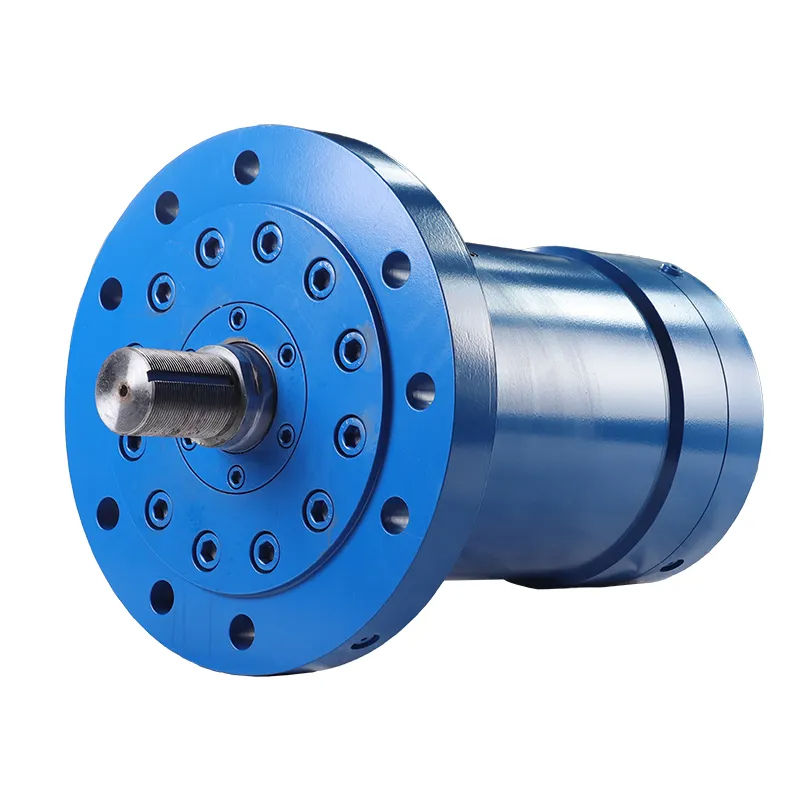
How to properly size a swing hydraulic cylinder for an application? This question isn't just about picking a part; it's the foundation of reliable machinery. Whether you're designing a robotic arm for precision assembly or a heavy-duty excavator bucket, an incorrectly sized cylinder leads directly to system failure, poor performance, and costly downtime. The challenge lies in translating complex mechanical requirements—load, torque, speed, and space constraints—into precise technical specifications. It’s a critical engineering decision where accuracy is non-negotiable. This guide cuts through the complexity, providing a clear, step-by-step approach to ensure your hydraulic swing motion is powerful, efficient, and durable. Partnering with a specialist like Raydafon Technology Group Co.,Limited can simplify this process, offering expert guidance and precisely engineered solutions that fit your application perfectly from the start.
1. The Precision Dilemma: Calculating Torque and Force Accurately
You need your industrial manipulator to rotate a 500kg payload smoothly. Guesswork on cylinder force leads to a sluggish arm that strains the motor or a dangerously overpowered one that risks structural damage. The core of proper sizing is precise calculation. First, determine the required torque at the pivot point. This involves the load weight, its center of gravity distance from the pivot, and any additional forces like friction or acceleration. This torque must then be converted into the linear force required from the cylinder rod, considering the cylinder's mounting geometry and effective lever arm. This is where expert support is invaluable. Companies like Raydafon Technology Group Co.,Limited provide not just cylinders but application engineering to verify these critical calculations, ensuring the selected cylinder delivers the exact force needed without compromise.
Key Parameter
Description
Typical Calculation/Consideration
Required Output Torque (T)
Rotational force needed at the pivot.
T = Load (N) x Distance to CG (m) x Safety Factor
Cylinder Force (F)
Linear force the cylinder must produce.
F = T / Effective Lever Arm (m)
Safety Factor (SF)
Multiplier for unexpected loads or shocks.
Typically 1.5 to 2.0 for dynamic applications
Bore Diameter
Determines the force area for a given pressure.
Based on F = Pressure x Piston Area
2. Space vs. Power: Navigating Mounting and Stroke Constraints
The machine frame has limited real estate, but the application demands a full 90-degree swing. Choosing a cylinder that's too long compromises the design; one with insufficient stroke fails the function. After force calculations, physical dimensions become the critical bottleneck. You must define the available space for the cylinder's retracted and extended length, its mounting clevis or trunnion dimensions, and the required angular movement (stroke). The cylinder's stroke directly dictates the achievable rotation angle based on the mounting geometry. A compact, high-power-density solution is often essential. This is a specialty of advanced manufacturers. How to properly size a swing hydraulic cylinder for an application? It requires balancing power with packaging. Raydafon's engineering team excels at designing cylinders that maximize performance within tight spatial envelopes, offering custom stroke lengths and mountings to integrate seamlessly into your machinery.
Key Parameter
Description
Impact on Sizing
Retracted Length (Lret)
Cylinder length when fully closed.
Must fit within the machine's minimum space.
Stroke Length (S)
Distance the rod travels from retracted to extended.
Directly determines the angular rotation achieved.
Mounting Style
Clevis, trunnion, flange, etc.
Affects envelope size, pivot points, and force vectors.
3. Speed and Control: Balancing Cycle Time with System Stability
Your automated production line needs fast cycle times, but the swing motion must be precise and jerk-free to avoid product damage. Sizing for speed introduces hydraulic flow requirements. The cylinder's bore size and stroke determine the oil volume needed to extend and retract. To achieve a desired swing time, you must calculate the necessary flow rate from the pump. However, a larger bore cylinder, while potentially offering more force, requires more flow to move quickly, which can increase system cost and complexity. Furthermore, rapid movement demands careful control of acceleration and deceleration to prevent hydraulic shock and ensure positioning accuracy. Optimizing this balance is key. Leveraging the technical expertise of a partner like Raydafon Technology Group Co.,Limited helps you model these dynamics, selecting a cylinder size that meets your speed targets while maintaining smooth, controllable motion for reliable operation.
Key Parameter
Description
Calculation/Relationship
Extension Speed (vext)
Desired rod extension speed.
vext = Stroke (m) / Extension Time (s)
Required Flow Rate (Q)
Hydraulic oil flow needed to achieve speed.
Q (L/min) = [Piston Area (cm²) x vext (m/s) x 6] / 10
Cushioning
Internal deceleration at stroke ends.
Critical for high-speed or high-mass applications to prevent damage.
Valve Sizing
Control valve capacity.
Valve flow rating must exceed cylinder's required Q for performance.
4. FAQ: Common Questions on Sizing Swing Hydraulic Cylinders
Q: What is the most common mistake when sizing a swing cylinder?
A: The most frequent error is underestimating the true torque requirement by neglecting the dynamic forces (acceleration/deceleration) or using an incorrect distance to the load's center of gravity. Always use a conservative safety factor and, when in doubt, consult with application engineers like those at Raydafon to validate your load analysis.
Q: How does mounting geometry affect the cylinder size I need?
A: Mounting geometry is critical. It determines the effective lever arm, which directly converts cylinder force into rotational torque. A poor mounting angle can drastically reduce mechanical advantage, forcing you to select a much larger, more powerful (and expensive) cylinder to achieve the same output torque. Optimized mounting design is part of How to properly size a swing hydraulic cylinder for an application?.
We hope this guide empowers your next design project. Have a specific challenge or unique application requirement? We encourage you to reach out for a detailed discussion. Share your thoughts or questions in the comments below.
For engineered solutions you can trust, consider Raydafon Technology Group Co.,Limited. With extensive expertise in precise hydraulic actuation, Raydafon provides not only high-quality Swing Hydraulic Cylinders but also comprehensive application sizing support to ensure optimal performance and reliability. Visit https://www.raydafon-pulleys.com to explore their capabilities or contact their engineering team directly via email at [email protected] for a personalized consultation.
1. Zhang, H., Wang, L., & Chen, J. (2020). Dynamic Modeling and Parameter Optimization for Hydraulic Swing Mechanisms in Construction Machinery. Journal of Mechanical Engineering, 56(15), 112-120.
2. Müller, S., & Krause, P. (2019). Influence of Cylinder Mounting Geometry on the Output Torque of Hydraulic Rotary Actuators. Proceedings of the Institution of Mechanical Engineers, Part C: Journal of Mechanical Engineering Science, 233(8), 2754-2764.
3. Li, Y., & Zhao, K. (2021). A Sizing Methodology for Hydraulic Cylinders in Robotic Manipulators Considering Inertial Loads. Robotics and Computer-Integrated Manufacturing, 68, 102075.
4. Peterson, G. R., & Svensson, O. (2018). Pressure Peaks and Cushioning Design in High-Speed Hydraulic Cylinders. International Journal of Fluid Power, 19(2), 88-99.
5. Tanaka, H., & Yamaguchi, T. (2017). Efficiency Analysis of Compact Hydraulic Swing Drives for Mobile Equipment. SAE International Journal of Commercial Vehicles, 10(2), 456-463.
6. Davis, R. M., & Thompson, A. W. (2022). Life Cycle Assessment and Robust Sizing of Hydraulic Actuators for Heavy-Duty Applications. Engineering Failure Analysis, 134, 106048.
7. Kim, S., Park, J., & Lee, H. (2019). Optimal Design of a Hydraulic Cylinder for a 180-Degree Swing Clamp Using Finite Element Analysis. International Journal of Precision Engineering and Manufacturing, 20(5), 789-797.
8. Johansson, A., & Andersson, B. (2020). Friction Modeling and Its Impact on the Sizing of Hydraulic Linear Actuators. Tribology International, 151, 106521.
9. Carter, F. L., & Benson, R. S. (2018). The Role of Safety Factors in the Mechanical Design and Hydraulic Component Selection for Industrial Machinery. Journal of Engineering Design, 29(10-12), 587-609.
10. Wagner, E., & Schmidt, M. (2021). Integrated System Approach for Sizing Hydraulic Cylinders and Selector Valves in Mobile Hydraulic Systems. Automation in Construction, 130, 103836.
We use cookies to offer you a better browsing experience, analyze site traffic and personalize content. By using this site, you agree to our use of cookies.Privacy Policy